Market Acts
How to Draft a Market Participation Agreement Under Italian Law
A market participation agreement looks straightforward until a trader arrives at 6 a.m. and finds someone else in the pitch, or a comune inspector asks for an authorization nobody attached to the file. Italian law does not have a single statute called a “market participation agreement.” In practice, it is a commercial contract between a market organizer and a participant — a company, a sole trader, or sometimes an association — who wants a defined space at a market. The legal shape changes depending on whether the market sits on public land or private property, and on the rules of the comune or the venue.
That is why a useful draft does three jobs at once. It records the commercial deal, maps the compliance obligations, and closes the formalities so the document can actually be used. Below is a step-by-step approach to the clauses, approvals, and signatures that make a market participation agreement workable under Italian law. This is general guidance, not legal advice; for a public market or a significant arrangement, have an Italian lawyer review the draft before signature.
1. Start With the Market, Not a Template
Before drafting a single clause, classify the market. A weekly farmers’ market in a public piazza is not the same as a private food hall, a temporary fair in a shopping centre, or a seasonal market on land owned by a foundation. For public-area commerce — commercio su aree pubbliche — the framework includes D.Lgs. 114/1998 and the regional and municipal rules that implement it. The organizer may be the comune itself or a concessionaire. If it is a concessionaire, read the concession carefully: it may limit sub-assignment, opening hours, or the categories of goods that can be sold.
If the market is private, the agreement is usually a licence or a short lease combined with services. Check the landlord’s consent and the permitted use under the head lease. A private courtyard may be perfect for a design market, but the lease may still prohibit retail sales or require fire-safety approvals.
Define the parties with precision: full legal name, registered office, VAT number, tax code, and legal representative. If the signatory’s authority is not obvious, attach an extract from the Registro delle Imprese or a board resolution. A beautifully drafted agreement signed by someone without power is an expensive draft.
2. Put the Commercial Deal in Plain Clauses
The commercial heart of the agreement should be readable without a legal dictionary. State the pitch or space, the dates and times, the permitted goods or services, and whether any exclusivity applies. “A 3m x 3m pitch in Zone B, from 6:00 to 14:00 on the first and third Saturday of each month” is better than “a suitable space.” Attach a plan if allocation matters.
Include the money clauses with the same clarity:
- Participation fee: amount, payment date, method, VAT treatment, and late-payment consequences.
- Deposit: amount, what it secures, when it is returned, and what may be deducted.
- Utilities and services: electricity, water, waste collection, cleaning, and who arranges and pays for each.
- Duration and renewal: fixed term, renewal mechanism, notice periods, and whether either party can withdraw early.
- Price review: if the agreement runs for years, say how and when the fee may change.
Attach the market rules as an annex and require the participant to comply with them. Avoid a clause that simply says “the market rules apply” without identifying the version. Rulebooks change, and a moving target is difficult to enforce.
3. Build Compliance Into the Contract
Compliance should appear as contractual promises, not as hopeful background assumptions. The participant should warrant that it holds the authorizations needed for its activity, that its products comply with Italian and EU rules, and that it has the insurance required by the organizer. If food is sold, the participant should confirm its HACCP notification and the health rules that apply to temporary stalls. The organizer should warrant that it has the right to grant use of the space and that the venue complies with the safety requirements it controls.
Insurance deserves its own clause. Ask for public liability cover, and where relevant product liability and employer liability. Specify the minimum cover, the obligation to name the organizer as an additional insured if required, and the duty to provide a certificate before the first market day. Data protection also belongs in the draft: state who is the controller and who is the processor for any personal data exchanged, and attach a privacy notice where needed.
Keep a document schedule in the agreement. A practical annex might list:
- identity and tax documents for the participant;
- trade authorization or SCIA, where required;
- insurance certificate;
- HACCP notification or food-business registration, if applicable;
- any product certifications or labels required by the market rules.
4. Draft the Operational Rules and Remedies
Most disputes at markets are not about grand legal principles. They are about set-up times, noise, waste, subletting, and who cleans the pitch. Put those rules in the agreement or in an annexed regulation, and make them specific. A good clause says what happens, not only what is forbidden. For example: “If the participant has not occupied the pitch by 7:00 without notice, the organizer may reallocate it for that day and retain the daily fee.” That is enforceable, understandable, and useful at 7:05.
Cover set-up and breakdown, vehicle access, signage, music and noise, waste separation, cleaning, conduct toward customers and other traders, and subletting. Then add remedies: a warning procedure, suspension for serious breach, termination for repeated breach, and forfeiture of the deposit where the agreement allows it. Include force majeure and weather cancellation, with a clear rule on refunds or credits. Finally, choose dispute resolution: mediation first, then the competent Italian court, or arbitration if the parties prefer it.
5. Obtain Approvals Before Signature
Approvals are where optimistic drafts go to die. Map them before the signing meeting. For a public market, the organizer may need a concession or occupancy title for the area, and the participant may need authorization to trade on public land. For food, the local health authority may require notification or inspection. For a private venue, the landlord, the condominium, or the fire-safety adviser may need to consent. Do not assume that silence equals approval.
- List every approval and consent the market and the participant need.
- Identify who issues each one and the expected timeline.
- Request them in writing and keep the responses.
- Attach the conditions to the agreement as conditions precedent or as schedule obligations.
- Set a deadline and a consequence if an approval is refused or delayed.
If an approval is still pending at signature, say so expressly. A short clause — “This agreement takes effect only when the participant provides the municipal authorization in Annex 2” — prevents a dispute about whether the market day should have gone ahead.
6. Signatures, Powers and Formalities
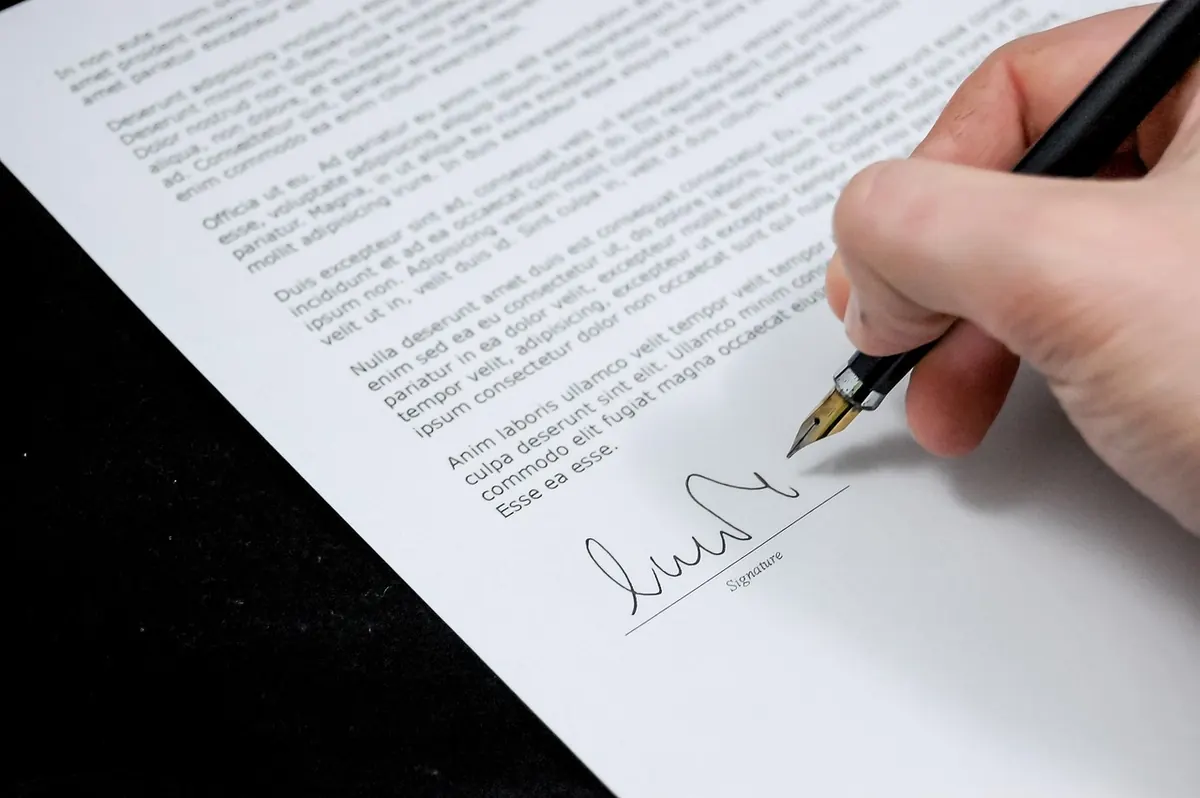
Check who signs and what they can sign. For companies, verify the legal representative’s powers or obtain a board resolution. For agents, require a written power of attorney. Use handwritten or digital signatures as the parties prefer; under Italian law, a qualified digital signature can be valid, but the contract should state the method and the delivery process. Initial each page and each annex, date the document, and keep a full original for each party.
If the agreement is in English but governed by Italian law, consider an Italian translation and state which version prevails. Public filings and dealings with a comune will usually require Italian. Check whether stamp duty, registration, or other formalities apply to the specific contract; this is one of those points where a local accountant or lawyer earns their fee. Finally, distribute signed copies to the people who run the market, not only to the legal department. A contract that lives only in an inbox does not solve the 6 a.m. pitch problem.
A Practical Closing Check
Before anyone signs, run a five-minute check: the parties are correctly identified; the pitch or space is described; the fees and deposit are clear; the market rules are attached; the insurance and authorizations are listed; the approvals are either obtained or made conditions; and the signatory has power. If any of those answers is vague, fix it now. A market participation agreement is a working document, and the best ones are boring in the right places: clear on money, clear on space, clear on compliance. For anything beyond a simple private market, take professional advice under Italian law before you sign.
Photo: jarmoluk / Pixabay